47% of the 116 casinos we reviewed have no verified licence
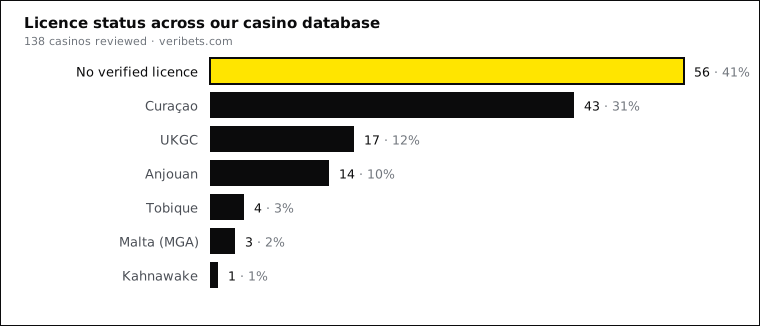
We checked the licensing status of all 116 casinos in our review database against operators’ own published terms, footer disclosures and licensor registers. This is a count of what we found, not a survey of any other outlet’s data — it’s our own dataset, and it’s the first time we’ve broken it down publicly.
This analysis covers the 116 casinos on record as of 13 August 2026, the date we ran the check. The database has grown since, and the chart above tracks the current, larger cohort — so treat every figure below as a description of that 116-casino snapshot, not a live count of today’s full database.
The headline number
54 of the 116 casinos in that snapshot — 47% — carried no licence we could verify at all. Not “unclear,” not “pending confirmation”: no licensing body named in the operator’s own terms that we could locate and check against a public register. That wasn’t a rounding error in a niche corner of the market. It was the single largest category in that dataset, bigger than any one jurisdiction below.
The jurisdictions we did find
Of the 62 casinos in that snapshot with a traceable licence, the breakdown was:
- Curaçao: 28 casinos (24% of the total) — the single largest licensed category, and also the most heterogeneous. “Curaçao licence” covers operators under the current centralized Curaçao Gaming Authority as well as older sub-licences issued before the 2023 regulatory overhaul. Roobet holds a current Curaçao Gaming Authority licence (OGL/2024/687/0427); Stake.com holds another (OGL/2024/1451/0918).
- UKGC: 17 casinos (15%) — the only jurisdiction in our data that consistently means something enforceable for a UK player. Grosvenor Casino operates under UK Gambling Commission licence 57924, held by Rank Interactive (Gibraltar) Limited.
- Anjouan: 10 casinos (9%) — a Comoros licensing body that has absorbed a wave of operators since Curaçao tightened its own rules in 2023. BC.Game moved to an Anjouan licence (ALSI-202410011-FI1) after its prior Curaçao entities were declared bankrupt in November 2024.
- Tobique: 4 casinos (3%) — a newer regulator, with the smallest footprint and shortest track record of any jurisdiction in our data. Spin Samurai Casino is licensed under Tobique Gaming Commission licence 0000002.
- Malta (MGA): 2 casinos (2%) — the second tier most players would recognize as reputable, alongside the UKGC. N1 Casino holds MGA/B2C/394/2017.
- Kahnawake: 1 casino (1%) — a long-standing tribal gaming regulator. JackpotCity Casino is licensed by the Kahnawake Gaming Commission (licence 00892) for its international site, running a separate MGA-licensed version for EU visitors.
What each tier actually means if a payout gets refused
This is the part that gets glossed over, and it shouldn’t be, because “licensed” is not one thing.
UKGC is a statutory regulator with enforcement powers over operators serving Great Britain: it can fine, suspend or revoke a licence, and it runs a formal dispute-resolution structure (via an approved Alternative Dispute Resolution provider) that a UK player can escalate to if a casino refuses a legitimate payout. It’s the closest thing in this list to a regulator that can actually make an operator pay.
MGA (Malta) sits close behind UKGC in practical terms — a real statutory authority with a licensee register you can check the licence number against, and a formal player-complaints process. It carries genuine weight across the EU, even if enforcement doesn’t always move fast.
Kahnawake is a self-regulating body run by the Mohawk Council of Kahnawake, with decades of history and a real complaints process, but it isn’t a government financial regulator in the sense UKGC or MGA are, and its enforcement reach outside its own dispute process is limited.
Curaçao is where the caveats start mattering. Since the 2023 overhaul that replaced the old “master licence” sub-licensing system with a centralized Curaçao Gaming Authority, licensing has tightened somewhat — but a Curaçao licence still carries far less regulatory weight than UKGC or MGA, with historically slower and less consistent enforcement against operators that mistreat players. If a Curaçao-licensed casino refuses a payout, a player’s practical recourse is limited mostly to filing a complaint with the CGA or an intermediary body and hoping the operator responds — there’s no equivalent of the UKGC’s statutory teeth behind it.
Anjouan and Tobique sit a tier below even that. Both are newer licensing bodies with far smaller track records, thinner public information about what enforcement they actually carry out, and no meaningful acceptance in stricter markets like the UK, Sweden or Ontario. A licence number from either body confirms an operator registered somewhere and paid a fee — it says very little about what happens if that operator later stops paying out.
No licence at all — the 47% in that snapshot — meant there was no regulatory body to appeal to if something went wrong. Whatever recourse existed was whatever the operator’s own terms and customer service chose to offer, with no external authority able to compel a resolution.
Why this matters more than the star rating
A Curaçao licence and a UKGC licence both get reported in casino marketing as simply “licensed,” and the word does a lot of work it hasn’t earned in the Curaçao case, let alone the unlicensed share of the market. The practical question worth asking before depositing isn’t “does this casino have a licence” — it’s “which licence, and what does that regulator actually do if this operator refuses to pay me.” Those are two very different questions, and in this snapshot the gap between them covered nearly half the 116 casinos we checked.
For a walkthrough of how to look up a licence number yourself, see our guide on how to check a gambling licence. Full scoring detail — including how licence tier factors into our overall casino ratings — is in our methodology.